B.Ed. Admission DCRUST

Deenbandhu Chhotu Ram University of Science and Technology (DCRUST) in Murthal, Haryana, provides a two-year B.Ed program. Admission is completely merit-based, with no admission exam. Candidates must have a bachelor’s or master’s degree with at least 50% (47.5% for reserved categories).

Eligibility: At least 50% in a bachelor’s or master’s degree in sciences/social sciences/humanities, or 55% for a bachelor’s degree in engineering/technology with a science and mathematics specialty. Haryana SC/ST/PwD applicants receive a relaxation of 47.5% (or 52.25% for engineering degrees).

Selection Process: Merit list based on qualifying exam scores, followed by institutional counseling.

Application Process: Registration and choice locking are completed online.

Required documents include class 10/12 certificates, qualifying degree mark sheets, a character certificate, a caste certificate (if applicable), and proof of Haryana residency.

B.Ed. Admission Step-by-Step

Step 1: Check the eligibility requirements. Before applying, make sure you match the strict academic cutoffs set by Haryana state universities. General and OBC categories require a minimum of 50% aggregate marks in your bachelor’s or master’s degree. SC/ST/PwD Categories: Minimum of 45% aggregate marks (applied to Haryana citizens). B.E./B.Tech. graduates must have at least 55% aggregate marks with a specialty in science and mathematics.

 Step 2: Online registration at the Nodal Portal Every year, the Haryana state government designates a single university (usually Chaudhary Ranbir Singh University—CRSU or Maharshi Dayanand University—MDU) to serve as the nodal organization for centralized counseling. When the official Haryana centralized B.Ed. admission portal becomes operational, visit it. Click on “New Registration” and enter your basic personal information, active mobile number, and email address.

Step 3: College Choice Filling and Locking (Most Important Step) Once your registration is completed, you must choose where you want to study. Access the “Choice Filling” area of your application dashboard. Select your favorite B.Ed colleges from the drop-down list of Haryana’s participating institutions. Prioritize your list. Rank your absolute dream colleges as Choice #1, Choice #2, etc. If your proportion is average, consider adding a few private self-financed universities to secure selection.

Step 4: Review the Merit List and Check Seat Allotment. The university processes all applications and ranks students depending on their graduation percentages: First, a provisional merit list is published. Check your information carefully. If there is an error in your name or marks, file a grievance online within the two-day repair period. Final Merit List and Allotment: The algorithm compares your merit rank to your sealed college selections. On the appointed allotment date, log onto the portal to view your assigned college and get your seat allotment letter.

Step 5: Physical Reporting and Document Verification. You will be given a rigorous three to four-day window to report to your assigned college in person. Travel to the designated college campus. Bring three sets of self-attested photocopies, along with your original documents, for verification. Printout of the Online Application Form and Seat Allotment Letter for Classes 10 and 12 Mark Sheets and Certificates; Graduation / Postgraduate Marksheets (all semesters/years) and degree certificates Migration Certificate (required if you graduated from a university outside Haryana). Haryana Domicile and Category/Caste Certificate (If Claiming Reservation) Character Certificate and Aadhaar Card

Step 6: Token Fee Payment and Admission Confirmation. Once the college staff has verified your original documents, your admission will be formally approved on the university portal backend. A payment link will be activated on your student login page, or the institution will request a bank demand draft. Pay the first-year academic fee. Collect your formal admission slip and fee receipt to reserve your seat and complete your enrollment.

JBT Admission

D.El.Ed. or JBT admission in Haryana is entirely merit-based, which means there is no entrance exam. Seats in both government DIETs and private self-financed colleges are allocated solely based on your Class 12 (10+2) marks. The State Council of Educational Research and Training (SCERT) of Haryana manages the online application process centrally.

Step 1: Review the eligibility conditions. Before submitting your application, ensure that you meet the stringent academic cutoffs set by SCERT Haryana: General category: Class 12 (10+2) requires a minimum of 50% aggregate grades across five subjects. SC/BC/PwD/EWS Categories: Minimum aggregate of 47.5% (applicable only to Haryana citizens). Mandatory Subjects: You must have taken English as a core or elective course in grade 12. You must also have studied Hindi or Sanskrit at the matriculation (Class 10) level.

Step 2: Online Registration at the DEL.ED Portal When the registration cycle goes live, the full process will take place online. Visit the official consolidated portal, dedharyana.org. To generate login credentials, click “New Registration” and enter basic information such as your name, mobile phone number, and email address. Log into your dashboard and complete the detailed form, including your exact Class 10 and Class 12 results. Upload the following documents: A recent passport-size photograph, your signature, and your Class 10 and 12 marksheets. Pay the registration fee by online net banking, debit card, or UPI.

Step 3: Filling out and locking in college choices (Critical Step) After paying, you must decide where you want to study. Your choices determine where you are placed. Navigate to the “Choice Filling” portion of your applicant site. Choose your favorite institute from the drop-down selection of government DIETs and private self-financed colleges. Minimum Selection: You must select a minimum of five colleges in order of preference. Rank your top colleges in order of preference: Choice #1, Choice #2, etc. Lock Choices: Review your college layout and then click “Lock Choices.” Unlocked choices will automatically lock at the final application deadline.

Step 4: Merit List Publication and Choice Correction SCERT examines all digital submissions and ranks applicants based only on their Class 12 aggregate percentage: The provisional merit list is published first. Make sure your rank, name, and grades are correct. Grievance Window: If there is a discrepancy or typing error in your grades, a 2-day window arises in which you can submit a correction request online. Final Merit List: SCERT distributes the definitive state merit list, determining seat allocation.

Step 5: Seat Allotment Rounds. Counseling is done in many rounds (usually Round 1, Round 2, and a final Spot Admission/Mop-Up Round): The automated program compares your absolute merit rank to your predetermined college choices. To check your status, go on to the site on the designated date. If you’ve been assigned a seat, go to your student dashboard to obtain your official seat allotment letter.

Step 6: Physical Reporting and Document Verification. You have a strict three to four-day window to secure your spot by showing up in person at the allotted institute: Travel to the designated government DIET or private college campus. Bring three sets of self-attested photocopies, along with your original documents, for verification. Printout of the Online Application Form and Seat Allotment Letter Class 10 Marks Card and Certificate (providing Hindi/Sanskrit required) Class 12 Marks Card and Certificate (Proving English requirement)Migration Certificate (Mandatory if your Class 12 school board was outside Haryana, such as CBSE or other state boards). Haryana Domicile and Category/Caste Certificate (If Claiming Reservation) Character Certificate and Aadhaar Card

Step 7: Fee Payment and Final Enrollment. Once the college verification committee has validated your original documents, your status on the SCERT backend portal will be changed to “Approved.” The payment system is enabled on your dashboard, or the college allows payment via demand draft. Pay course costs AND collect your physical admission receipt from the college clerk to complete your enrollment.

PGDCA (Distance Education)

The Post Graduate Diploma in Computer Applications (PGDCA) through Open and Distance Learning (ODL) is a popular, flexible one-year postgraduate program that teaches essential IT skills without requiring regular classroom attendance. It is popular among graduates and working people who want to go into the software and IT industries. Courses approved by the UGC Distance Education Bureau PGDCA are valid for government and private sector positions.

MBA Specialisations

MBA

MBA Dual Specialisation is a two-year postgraduate degree program that enables you to study and master two distinct business functional areas at the same time. Instead of focusing on a single core field (such as finance), you graduate with expert-level knowledge in two distinct but frequently complementing domains.

University Admission Center

University admission centers offer counseling, application processing, and centralized admission services to local students. Depending on desired university courses, you can utilize online portals or contact physical help desks in universities.

BA General Distance Education

The BA program is open to anybody interested in a career in the social sciences or humanities. As time has passed, the area of business analysis has branched into various subfields, greatly broadening the scope of the BA’s available work opportunities. Elective courses in BA: Hindi, English, Political Science, History, Economics, Sociology, and Mathematics Programme Duration A Bachelor of Arts (B.A.) has a minimum duration of three years. Maximum duration: 6 years. Eligibility and Fees The eligibility standards for online/distance B.A. programs are far too liberal. To pursue an online and distance B.A., one must have completed 10+2 at any approved university. There are no entrance exams for admission to online and distance B.A. courses. S. No. Fees for the program and examination 1. Annual income: Rs. 10,000 or Rs. 2,000.

Subharti dde Admission

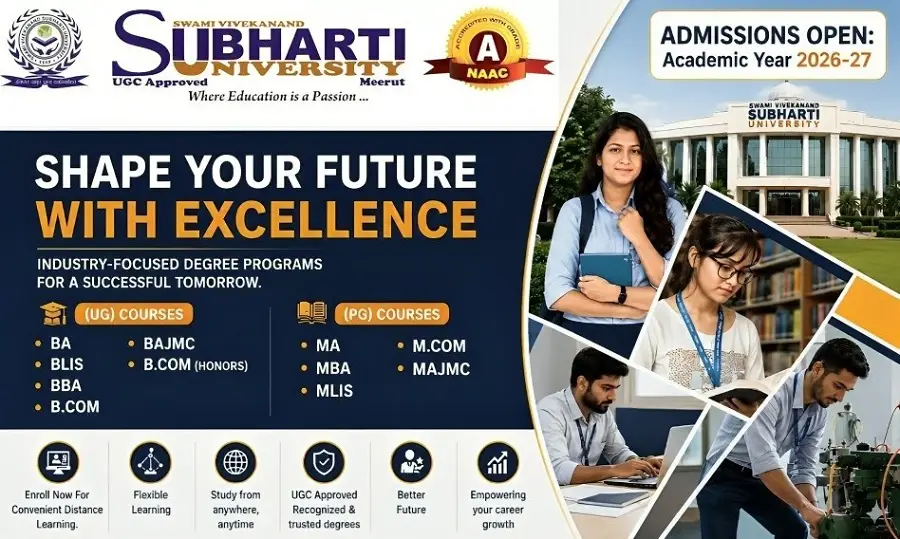
Swami Vivekanand Subharti University (SVSU) invites admissions for the July 2026 intake.

🎓 University Highlights:

NAAC A-Grade University

UGC-DEB Approved

📘 Courses Offered under DDE:

*NOTE* : ” *ABC ID or DEB ID is mandatory.”* ✅

*Undergraduate Programs:*

*B.A. (General – Combination of any 3 subjects)*

*B.A. (Hindi, English, Political Science, History, Mathematics, Economics, Sociology, JMC)*

*B.LIS*

*BBA*

*B.Com*

*B.Com (Hons)*

*Postgraduate Programs:*

*M.A. (Buddhist Studies, Education, Public Administration, Home Science)*

*M.A. (JMC, Political Science, Mathematics, Sociology, Economics, English, History)*

*M.LIS*

*M.Com*

*MBA (General – Combination of any 2 specializations)*

*Information Technology*

*Human Resource Management*

*Marketing Management*

*Financial Management*

*Supply Chain Management*

*Operations Management*

*Project Management*

📞 9711356677

Subharti University Distance Education

Enrolling in Swami Vivekananda Subharti University’s online education program is an ideal choice for working professionals, women, and students who are unable to attend a traditional college. Accreditation is one of its primary benefits.

The UGC-DEB (Distance Education Bureau) and AICTE have recognized and approved the university’s distant learning courses. Accreditation and Grading: Subharti University has an ‘A’ rating from NAAC, assuring that your degree is valid throughout the country. Annual costs for undergraduate (UG) studies start at around ₹10,500, while postgraduate (PG) courses vary from ₹15,500 to ₹30,000, making them fairly affordable. Admission Process: There is no entrance exam; enrollment is based on previous academic performance.

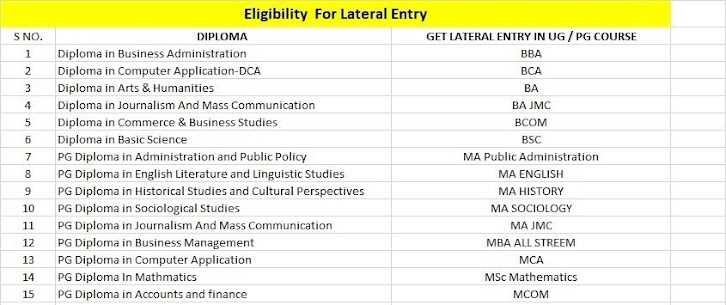
Lateral Entry Admission, July 2026

Lateral Entry permits you to skip the first year of a degree program and enroll directly in the second year (third semester), saving you time and money. This method is commonly employed after completing a polytechnic or post-graduate (PG) diploma to advance directly to higher educational levels.

Courses Eligibility

error: .